
The year was 1947, and India had just been cut in half. Not by rivers or railroads, but by religion. The Muslim League had demanded a nation, Pakistan, not because of some cultural eccentricity, but because Islam, as it saw itself, could not live under a civilisation governed by Dharma. That’s what the votes said. That’s what the riots declared. It was civilisational incompatibility, democratically expressed.
And yet, on the morning after this grand rupture, India declared herself “secular.” As if nothing had happened. As if the severing of the subcontinent was a mere cartographic hiccup.
The truth is, something deeper was buried that day. A nation was born, yes, but a civilisation was sidelined, folded quietly behind the preamble, boxed out of the articles, remembered in poetry but erased in policy. And that civilisation was Sanātana Dharma.
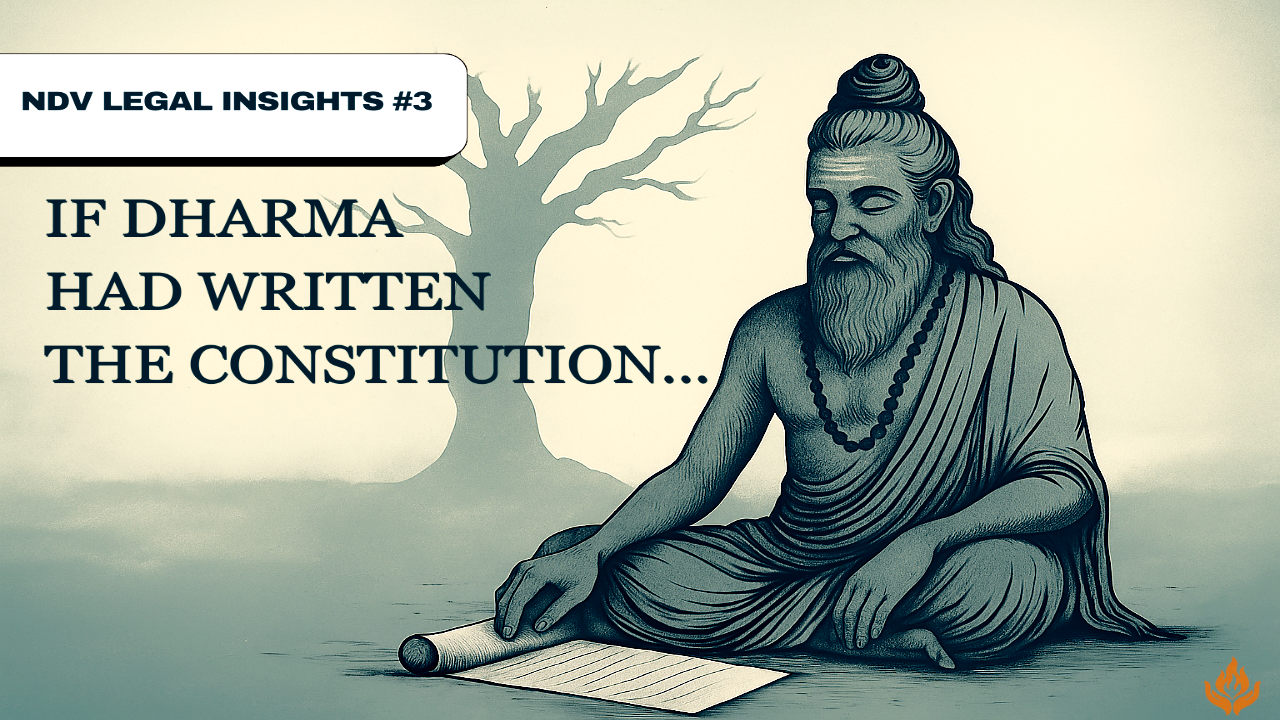
One wonders sometimes, what would a constitution have looked like if Dharma had been invited to the table?
It would not have been theocratic. Dharma never needed state violence to preserve itself.
But it would have been rooted, rooted in the memory of the land, in the ethics of restraint, in the grammar of truth and non-violence.
A dhārmic constitution would have recognised the cow as sacred not because of political populism but because of metaphysical continuity, because she is, in this civilisation, the very symbol of nourishment without violence. That’s why she was central to village life, temple offerings, even coronation vows.
But in the Constitution that was written, cow protection was reduced to a non-binding suggestion. Article 48. A Directive Principle. Not a right. Not a duty. Just an afterthought.
At the same time, the same Constitution left a loophole for ritual slaughter. If your religion demanded the blood of an animal, the courts would protect it. But if your dharma asked you to protect the cow as mother, the state would call it sentiment.
So the old harmony was broken. Dharma asked for non-violence, the Constitution allowed the knife.
The imbalance did not end there.
Take the temples. In the world of Dharma, a temple is not just a place of prayer. It is a legal world, a jurisdiction of its own. The deity is a juridical person. The rituals are not random, they are rule-bound, scripturally governed, and metaphysically precise.
But the Constitution didn’t understand that. Or perhaps it refused to.Temples were not protected, they were taken.
Hindu temples became “public property,” managed by state boards, overseen by officers, audited, taxed, restructured. Priests were appointed by governments. Lands were seized in the name of public good.
Meanwhile, no mosque was touched. No church was regulated. A Muslim Waqf Board could hold 8 lakh acres and still be free of state interference, but a small village temple had to take permission to build a shed.
One system was left to flourish, the other was brought under management. And all of it, every word, every clause, was said to be “secular.”
Even more disturbing is the way temple wealth, generated by devotees, sustained by ritual, consecrated as sacred trust, has been dispossessed of its original owners. It is Hindu wealth, born from dharmic bhāva, but Hindus have no control over it. It does not matter how ancient the temple, how rooted the tradition, the legal status renders the community irrelevant.
This is not merely a bureaucratic oversight. It is a civilisational displacement of the most serious order. A people have been stripped of control over their own sacred economy, while being told that secularism demands it. It is not hypocrisy. It is a quiet legal dispossession masquerading as governance.
It goes deeper still.
When Muslims demanded Pakistan, they didn’t ask only for a flag. They wanted an Islamic cultural homeland, a place where their laws, their calendar, their way of life would not be diluted. And they got it. But when Hindus, who stayed behind in India, assumed that this land, their only land, would allow their civilisation to breathe, they were mistaken.
The Constitution granted Muslims Article 30, the right to manage their own schools, their own institutions, with their own priorities. But Hindu institutions were left at the mercy of regulators.
A madarsa could teach the Qur’an with public funding, but a gurukula teaching the Vedas would be marked “communal.” This was not equality. This was inversion, enacted in law. A homeland that could not bear to call itself Hindu, a Constitution that protected every identity except its own.
Even in jurisprudence, the drift became visible.
Hindus came to the courts asking for their customs to be respected. But time and again, they were told that their rituals must pass the test of “essentiality.” That is, the court would now decide whether your faith deserved protection, based on whether it was central enough to your religion. Who decides that?
Not the ācārya. Not the paramparā. Not the community. A judge. A judge trained in secular law, perhaps unfamiliar with dharmic metaphysics, would now decide whether a thousand-year-old ritual was “essential.”
And so it happened, at Sabarimala, in temple entry cases, in festivals across the country, that Dharma was placed on trial, and told to defend itself using alien logic. No other faith is subjected to this. No other civilisation is asked to translate itself into the language of its coloniser to survive in its own homeland.
And amid all this, there lies a brutal irony, Hindus pay the highest price to fund this system that marginalises them. Over 80% of India is Hindu. That means the majority of taxpayers, revenue generators, and economic contributors are Hindus. But this demographic reality has no reflection in the allocation of rights, institutional autonomy, or cultural space.
There is no legal framework that even attempts to proportion public support or institutional respect in relation to this demographic contribution. On the contrary, the majority’s resources are often channelled into a system that denies them parity, ownership, or protection.
A civilisation pays the bill, yet is treated like an afterthought in its own home.
So we must ask, what was this Constitution really trying to build? It gave the language of liberty. But liberty for whom? For those who had already claimed a homeland on religious identity? Or for those whose homeland was now being made to feel like it must forget who it is, just to fit the frame?
Dharma does not seek vengeance. It does not need supremacy. But it needs space. It needs honesty. A republic built on its soil must at least allow it to speak. To govern its temples. To protect its ethics. To preserve its metaphysics, not as private belief, but as public truth.
Until then, what we have is not secularism. It is a slow suffocation, passed off as constitutional balance. And yet, Dharma survives. Not because the Constitution protected it. But because the people still remember. In silence. In ritual. In defiance.
But memory alone cannot hold a civilisation forever. At some point, law must remember too. And when that happens, when the Constitution begins to look not Westward but inward, perhaps then, Dharma will no longer have to apologise for wanting to live in the land it made sacred.
Not as a guest. But as its rightful soul.